

U.S. hospitals record tens of millions of admissions each year—roughly 33.9 million in the most recent American Hospital Association survey data—and every one of those encounters generates clinical data across EHRs, lab results, imaging, notes, devices, and other care settings. At the same time, global healthcare data is estimated to have grown from 5,800 exabytes in 2023 to roughly 10,800 exabytes by 2025—yet much of that information remains difficult to structure, analyze, and act on.
Yet despite this abundance, an estimated 97% of clinical data generated in hospitals goes unused, according to the World Economic Forum.
That’s where medical chart abstraction, also known as clinical data abstraction, plays a vital role. For hospitals and health systems, automating this process—especially when supported by clinical data experts through a Collaborative Intelligence™ model—can unlock critical insights, reduce the burden on internal teams, and ultimately help deliver more timely, personalized, and effective care.
What is Medical Chart Abstraction?
Clinical data abstraction, sometimes referred to as medical chart abstraction, is the systematic extraction of structured and unstructured data elements from patient medical records—both electronic health records (EHRs) and paper-based charts.
This process involves identifying, validating, and codifying key data points such as patient demographics, past medical history, medications, allergies, lab results, procedure notes, and diagnostic findings. The abstraction workflow often includes cross-referencing multiple data sources, reconciling inconsistencies, and ensuring that data is usable for secondary purposes.
Healthcare organizations leverage clinical data abstraction for a wide range of use cases, including:
- Quality reporting and performance improvement (e.g., eCQMs, core measures)
- Clinical research and trial readiness
- Regulatory compliance and audit support
- Value-based care initiatives
- Clinical decision support and population health management
By enabling accurate and scalable data capture, abstraction ensures that clinically relevant information can be repurposed for analytics, benchmarking, and actionable insights—improving both operational outcomes and patient care delivery across health systems.
How is Data Abstracted From Clinical Records?
Clinical data abstraction typically occurs through two methodologies: manual abstraction, performed by trained specialists, and automated abstraction, supported by advanced software and AI.
In manual abstraction workflows, trained clinical abstractors review patient records—both structured and unstructured—to identify and extract predefined data elements. These may include diagnosis codes, procedure history, medications, lab results, and social determinants of health (SDOH), depending on the intended use case (e.g., registry submission, research, or quality improvement).
A typical manual abstraction process includes:
- Defining abstraction requirements – Based on registry, quality, or research goals
- Developing standardized abstraction protocols – SOPs and data dictionaries
- Training abstraction personnel – Often nurses or HIM professionals
- Manual chart review – EHR navigation and cross-source validation
- Data entry and verification – Entry into abstraction platforms or spreadsheets
- Quality assurance (QA) – Dual abstraction, inter-rater reliability (IRR)
- Reporting and analysis
While effective at smaller scales, manual processes are resource-intensive and carry a higher risk of variability and data entry error. A 2018 study published in JAMIA Open found manual abstraction to be associated with the highest rate of data discrepancies across clinical workflows.
Automated medical chart abstraction augments or replaces manual processes using a combination of clinical data management platforms, AI models (including natural language processing for unstructured text), and structured data pipelines. These tools help standardize and accelerate abstraction across large, multisite data environments.
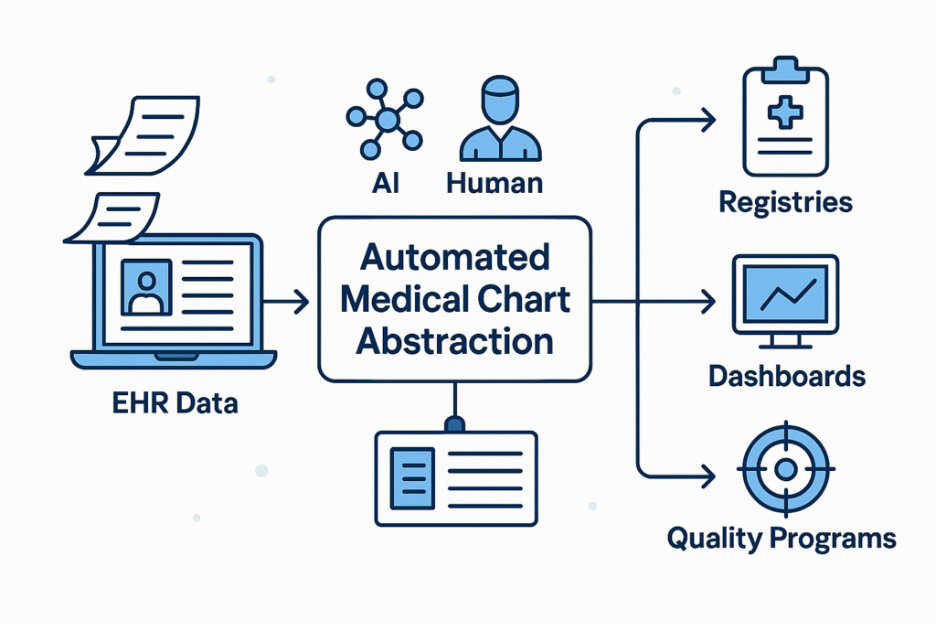
Automation is most effective when paired with clinical experts who can interpret context, validate extracted values, and manage exceptions, an approach often called Collaborative Intelligence,—especially in complex disease areas like oncology, cardiology, and infection prevention.
What is Clinical Data Management Software?
Clinical data abstraction is a complex process, and clinical data management software powered by AI technologies can take on this complexity. Software like this can improve data integrity. It can also yield insights to improve business performance and efficiency. This can be done on both a macro and micro level.
Clinical data management software features include:
- Data collection.
- Data storage.
- Data aggregation, curation, and transformation.
- Analysis and reporting, including dashboards and scorecards.
What Are the Benefits of Automating Clinical Data Abstraction and Management?
Medical researchers, hospitals, and health systems can benefit from automating clinical data abstraction and management. This is especially true for those participating in value-based care programs.
Clinical registries are widely used for quality improvement, benchmarking, and clinical decision support, but manual data entry remains common. In one national landscape survey of clinical registries, 88% reported using manual data entry, underscoring the continued need for automation and data-management support. Source
Clinical data is becoming more plentiful and complex. High-end computing solutions, such as AI technologies, are often the best choice for analysis when supported by human clinical data expertise. But we know these technologies are only as good as the input they receive. Poorly organized or managed data will yield poor results.
AI tools enable talented humans to explore data deeply. This exploration can uncover patterns and trends that form true business intelligence. Automation is just the beginning. When you combine data experts, data integrity, and AI-powered analytics, an approach we call Collaborative Intelligence, through automated clinical data abstraction and management, you gain actionable insights. These insights turn into best practices that fuel ROI, operational excellence, compliance with regulations, agility, and growth.
The benefits of automating clinical data abstraction extend across operational, clinical, and financial domains. Healthcare systems implementing automated abstraction platforms typically experience:
- Reduced abstraction time by 40–60%, particularly in high-volume registries
- Improved data completeness and IRR scores, critical for regulatory compliance
- Scalable registry participation across service lines and facilities
- Enhanced real-time reporting for executive dashboards and payer reporting
- Stronger patient matching and care coordination via centralized data hubs
How Does Clinical Data Abstraction and Management Software Centralize Data From Multiple Facilities?
According to a study published in the Journal of the American Medical Informatics Association, 79% of patients received care at more than one facility during the calendar year studied. The authors found that quality measures calculated using single-site electronic medical record data may be limited. Incomplete information can affect healthcare payments, patient safety, and care quality.
Automated clinical data abstraction and management software can centralize data from multiple health systems. This includes electronic health records, clinical trials, and patient registries. It provides a single platform for the storage and management of data from across an entire healthcare enterprise. This can be beneficial for several reasons, including:
- Improved efficiency by making it easier for clinical data experts and abstractors to access and analyze data from multiple sources.
- Reduced costs by eliminating the need to maintain multiple data systems.
- Improved quality by making it easier to ensure that data is accurate and complete.
- Increased transparency by making it easier to share data with other researchers and the public.
Conclusion
The value of high-quality clinical data in healthcare is undeniable—and automated medical chart abstraction is proving essential to unlocking it. By automating critical components of the clinical data abstraction process, healthcare providers and researchers can reduce manual workload, enhance data integrity, and focus more fully on improving patient care, with clinical judgment kept at the center through a Collaborative Intelligence approach.
As pressure mounts to drive better outcomes and reduce costs, adoption of automation in data abstraction and management will only accelerate. Organizations that embrace these technologies today are better positioned to generate real-time insights, scale participation in key programs, and deliver more informed, efficient, and personalized care across their systems.